ERROR: The site was unable to play back audio. Please try reloading the page in your browser (press Ctrl+F5). If this does not solve the problem we kindly ask you to update your browser to the latest version. If you already have the latest version, you we ask you to try another browser.
ERROR: The site was unable to play back audio. In order to solve the problem we kindly ask you to update Adope Flash Player on your computer to the latest version. If you already have the latest version, you can try to reinstall it. Also make sure that Flash is not deactivated in your browser.
On With this setting turned on you proceed from one exercise to another by clicking the button next. We recommend this setting for at calmer screen dsiplay. Please note: You can hit the enter key instead of clicking the button.
Off When the setting is turned off the exercises are displayed automatically one after another without a pause.
Green: Number of correct answers
Red: Number of wrong answers
Black: Total number of exercises
Underline: When a number increases, it is underlined
The system counts like this:
Right answer
- when the answer is correct
- when the field is empty
Wrong answer
- when the field contains a wrong answer
You can correct the numbers yourself
Click on the red and green numbers next to Now to make a correction.
Remember to save your score
When you have done your exercises, you are offered to save the score as the best score.
To keep the old best score you just do not save the new one.
Practice the Spanish pronouns with our online learning tools - lots of interactive exercises for beginners, advanced learners and experts!
The system gives you full control of the level of difficulty of the exercises and you can progress as you please and in your own tempo. All execises come with a translation of the vocabulary allowing you to practice freely without the need of a dictionary.
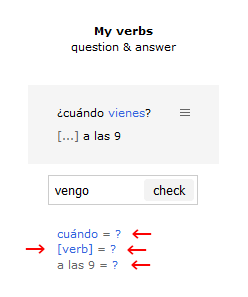
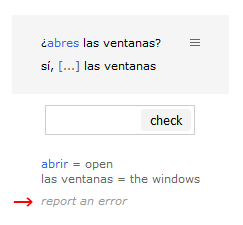
Below you will find a demo of some of the exercises on Spanish pronouns. Click on show exercises to try for yourself:
Spanish pronouns - direct object (accusative)
Insert the correct Spanish direct object pronoun (me, te, lo, la, nos, os, los, las)
*¿despertáis al francés?**sí, *despertamos*sí, lo despertamos sí, le despertamos*sí, lo despertamos sí, le despertamos***********svar*despertar = wake francés = French *lo*despertar;presente*
*¿ayudáis al médico?**sí, *ayudamos*sí, lo ayudamos sí, le ayudamos*sí, lo ayudamos sí, le ayudamos***********svar*ayudar = help médico = doctor *lo*ayudar;presente*
*¿contáis el chiste a Camila y Renata?**sí, *contamos el chiste*sí, les contamos el chiste*sí, les contamos el chiste***********svar*contar = tell, tell about, count chiste = joke *lo*contar;presente*
*¿mandas las cartas a Sofía?**no, no *mando las cartas*no, no le mando las cartas*no, no le mando las cartas***********svar*mandar = send, order, be in charge carta = letter *las*mandar;presente*
dar = give información = piece of information chico = boy, young man
*¿das las informaciones a los chicos?**sí, *doy las informaciones*sí, les doy las informaciones*sí, les doy las informaciones***********svar*dar = give información = piece of information chico = boy, young man *las*dar;presente*
*¿preparáis el postre a la chica?**sí, *preparamos*sí, se lo preparamos*sí, se lo preparamos***********svar*preparar = prepare postre = dessert chica = girl, young woman *lo*preparar;presente*
llevar = carry, bring, wear regalo = present, gift señora = Madam, Mrs, lady
*¿lleváis el regalo a las señoras?**sí, *llevamos*sí, se lo llevamos*sí, se lo llevamos***********svar*llevar = carry, bring, wear regalo = present, gift señora = Madam, Mrs, lady *lo*llevar;presente*
mandar = send, order, be in charge equipaje = luggage, baggage muchacha = girl, young woman
*¿mandas el equipaje a las muchachas?**no, no *mando*no, no se lo mando*no, no se lo mando***********svar*mandar = send, order, be in charge equipaje = luggage, baggage muchacha = girl, young woman *lo*mandar;presente*
You can access The Spanish Study on smartphone and tablet (iOS/Android).
All you need to do is to open the browser on your device and go to www.thespanishstudy.com.
The system will automatically detect your device and direct you to the version (web app) matching your screen size.
There is nothing to download or install on your device.