ERROR: The site was unable to play back audio. Please try reloading the page in your browser (press Ctrl+F5). If this does not solve the problem we kindly ask you to update your browser to the latest version. If you already have the latest version, you we ask you to try another browser.
close
ERROR: The site was unable to play back audio. In order to solve the problem we kindly ask you to update Adope Flash Player on your computer to the latest version. If you already have the latest version, you can try to reinstall it. Also make sure that Flash is not deactivated in your browser.
Each word list has individual scores on each mode option:
1-2 (English-Spanish), 2-1 (Spanish-English) and audio 2-1
Off:
There is only one score for each word list.
The score is shared by all mode options
close
Peeking
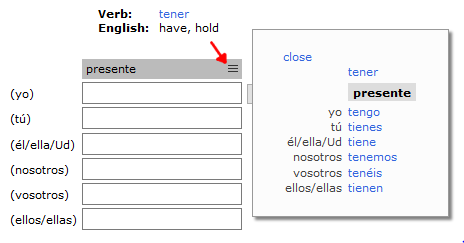
When leaving this setting on, you can have the conjugation shown by clicking on the three lines
close
Hide translations
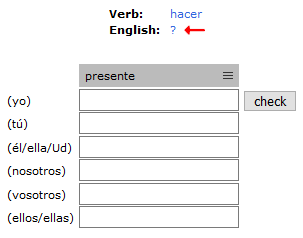
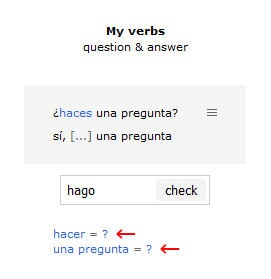
Turn this setting on to practise the meaning af the verbs and words used in the exercises while practising conjugations and grammar.
You can have the translation displayed and check your memory by clicking on the question mark or hitting the [arrow up] key.
Ex 1
Ex 2
close
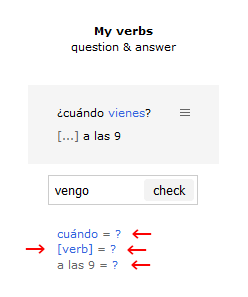
Hide infinitive
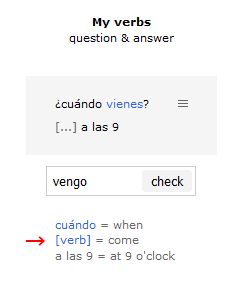
Turn this setting on to hide the infinitive of the verb in exercises where recognition of the verb is part of the exercise.
You can have the infinitive displayed and check your memory by clicking on [verb] or hitting the [arrow up] key.
You can challenge your memory further by turning the setting hide translationson at the same time:
close
Allows the system to respond with a .
close
next button
On With this setting turned on you proceed from one exercise to another by clicking the button next. We recommend this setting for at calmer screen dsiplay. Please note: You can hit the enter key instead of clicking the button.
Off When the setting is turned off the exercises are displayed automatically one after another without a pause.
close
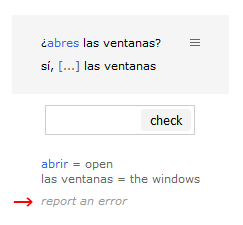
Report an error
Make use of this function to let us know about errors and misspellings.
Turning this setting off will remove the option.
close
Keep score
Best:15520(75%) Now:5220(%)
Green: Number of correct answers
Red: Number of wrong answers
Black: Total number of exercises
Underline: When a number increases, it is underlined
The system counts like this:
Right answer
- when the answer is correct
- when the field is empty
Wrong answer
- when the field contains a wrong answer
You can correct the numbers yourself
Click on the red and green numbers next to Now to make a correction.
Remember to save your score
When you have done your exercises, you are offered to save the score as the best score.
To keep the old best score you just do not save the new one.
The Spanish verb gustar is used to express that you like something in Spanish. However, the verb itself means to please and the Spanish sentence therefore differs from the English in terms of structure.
gustar = to please
Example: The sentence I like the music would in Spanish be me gusta la música - corresponding to the music pleases me.
The Spanish Study offers a tool allowing you to practice the use of the verb gustar with full user control of the level of difficulty of the exercises. See examples below.
Answer using gustar + dative pronoun
In this type of exercises you are asked to answer the question by inserting the correct form of gustar and the correct dative pronoun. Ex:
te gusta el coche? - sí, me gusta mucho
show exerciseshide exercises
¿qué piensas del jardín?
no -----en absoluto
√
no me gusta en absoluto
÷ Press Ctrl+Enter to see the answer
qué = what pensar = think jardín = garden en absoluto = not at all
*¿qué piensas del jardín?**no *en absoluto*no me gusta en absoluto*no me gusta en absoluto*jardín**********chepensi*qué = what pensar = think jardín = garden en absoluto = not at all ***
¿te gusta el puente?
sí, -----
√
sí, me gusta
÷ Press Ctrl+Enter to see the answer
puente = bridge
*¿te gusta el puente?**sí, **sí, me gusta*sí, me gusta*puente**********miti*puente = bridge ***
You can increase the level of difficulty by allowing both singular (gusta) and plural (gustan) forms of gustar:
show exerciseshide exercises
¿qué piensas del nombre?
no -----en absoluto
√
no me gusta en absoluto
÷ Press Ctrl+Enter to see the answer
qué = what pensar = think nombre = name en absoluto = not at all
*¿qué piensas del nombre?**no *en absoluto*no me gusta en absoluto*no me gusta en absoluto*nombre**********chepensi*qué = what pensar = think nombre = name en absoluto = not at all ***
¿te gustan los paises?
no, no -----tanto
√
no, no me gustan tanto
÷ Press Ctrl+Enter to see the answer
país = country tanto = a lot
*¿te gustan los paises?**no, no *tanto*no, no me gustan tanto*no, no me gustan tanto*país**********miti*país = country tanto = a lot ***
¿qué piensas de los apartamentos?
-----
√
me gustan
÷ Press Ctrl+Enter to see the answer
qué = what pensar = think apartamento = apartment, flat
*¿qué piensas de los apartamentos?****me gustan*me gustan*apartamento**********chepensi*qué = what pensar = think apartamento = apartment, flat ***
¿te gusta caminar?
sí, -----
√
sí, me gusta
÷ Press Ctrl+Enter to see the answer
caminar = walk
*¿te gusta caminar?**sí, **sí, me gusta*sí, me gusta*caminar**********miti*caminar = walk ***
Rewrite using gustar + dative pronoun
In this type of execises you are asked to rewrite the sentence using gustar + dative pronoun. Ex:
adoro a los niños - me gustan los niños
show exerciseshide exercises
adoras los cuentos
-----los cuentos
√
te gustan los cuentos
÷ Press Ctrl+Enter to see the answer
adorar = worship, adore cuento = fairy tale
*adoras los cuentos***los cuentos*te gustan los cuentos*te gustan los cuentos*cuento**********medpron*adorar = worship, adore cuento = fairy tale ***
adoras las montañas
-----las montañas
√
te gustan las montañas
÷ Press Ctrl+Enter to see the answer
adorar = worship, adore montaña = mountain
*adoras las montañas***las montañas*te gustan las montañas*te gustan las montañas*montaña**********medpron*adorar = worship, adore montaña = mountain ***
Furthermore you can work with sentences with double dative object. Ex:
Maria adora los dulces - a Maria le gustan los dulces
tú adoras leer - a ti te gusta leer
show exerciseshide exercises
Tomás adora las iglesias
-----las iglesias
√
a Tomás le gustan las iglesias
÷ Press Ctrl+Enter to see the answer
adorar = worship, adore iglesia = church
*Tomás adora las iglesias***las iglesias*a Tomás le gustan las iglesias*a Tomás le gustan las iglesias*iglesia**********udenpron*adorar = worship, adore iglesia = church ***
yo adoro los libros
-----los libros
√
a mí me gustan los libros
÷ Press Ctrl+Enter to see the answer
adorar = worship, adore libro = book
*yo adoro los libros***los libros*a mí me gustan los libros*a mí me gustan los libros*libro**********udenpron*adorar = worship, adore libro = book ***
vosotros adoráis la ropa
-----la ropa
√
a vosotros os gusta la ropa
÷ Press Ctrl+Enter to see the answer
adorar = worship, adore ropa = clothes, clothing
*vosotros adoráis la ropa***la ropa*a vosotros os gusta la ropa*a vosotros os gusta la ropa*ropa**********udenpron*adorar = worship, adore ropa = clothes, clothing ***
All the types of exercises above can be mixed as it pleases you. You will find the exercises on gustar under grammar in the top menu.
Try a FREE SUBSCRIPTION
Web apps: Smartphone & tablet (?)
cookies |
terms |
privacy policy
close
Cookies
The website applies cookies in order to make the interactivity work.
We also make use of Google Analytics to collect visitor statistics.
Web apps
close
You can access The Spanish Study on smartphone and tablet (iOS/Android).
All you need to do is to open the browser on your device and go to www.thespanishstudy.com.
The system will automatically detect your device and direct you to the version (web app) matching your screen size.
There is nothing to download or install on your device.